

motivation for our work
Molecular Ion Trapping
We perform research on trapped molecular ions, sympathetically cooled to milliKelvin temperatures via their Coulomb interaction with laser-cooled atomic ions. While production of cold atoms is routine, technology to obtain sub-Kelvin molecules is very new and opens up a number of exciting possibilities.
Controlling Chemistry at the Quantum Level
The long hold times and extreme environmental isolation of ion traps offer an ideal setup for quantum manipulation of molecules and full quantum control of their chemical reactions. Coherent control of molecular states and reaction pathways would lead to state-to-state control of chemical reactions, allowing us to fully understand and fully manipulate chemical reactions at the most fundamental level.
Quantum Information Processing
Polar molecules have much stronger long-range dipole interactions, as compared with atoms, as well as a much larger number of internal quantum states. Once the challenges of reliable molecular state preparation and readout are solved, trapped molecular ions could serve as qubits or memory elements in a quantum computer or as elements in a quantum simulator. Hybrid systems, where molecules are coupled with external circuits, is also an interesting possibility.
Are Fundamental "Constants" Really Constant?
Time-variation of fundamental "constants" is generally expected in many extensions of the Standard Model. Limitations of traditional molecular spectroscopy, as compared with atomic spectroscopy, have created a situation where laboratory sensitivity to a changing electron-proton mass ratio is orders of magnitude worse than sensitivity to a changing fine structure constant. Precision spectroscopy of milliKelvin molecular ions will allow substantial improvements in laboratory sensitivity to time-variation of the mass ratio, of particular interest both because of high-energy theory and astrophysical observations.
What is Dark Matter?
It is known from gravitational observations that the bulk of the matter in the universe is composed of so-called dark matter, which has properties not matching that of any known particle. One viable candidate for dark matter is quantum excitations of a new light scalar field not included in the Standard Model of particle physics. If scalar field dark matter exists, it can lead to oscillations of fundamental constants, such as the electron-proton mass ratio, potentially on observable timescales. Precision molecular spectroscopy is a good tool for searching for these oscillations.
Are Mirror-Image Molecules Identical?
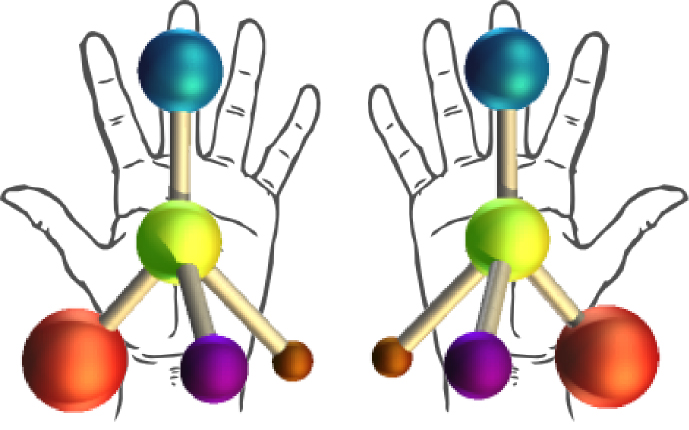
Chiral molecules with right- and left-handed configurations are normally assumed to be mirror images of one another. However, the weak nuclear force induces a small parity-violating effect which should cause right- and left-handed molecules to vibrate at slightly different fundamental frequencies. A first observation of this effect could be made with milliKelvin trapped molecular ions, and precise measurements would probe for new physics such as energy-dependence of the weak mixing angle. Currently, our lab is only working with non-chiral diatomic molecules, but we anticipate that the technology we develop for these simpler species will eventually impact searches for mirror-symmetry breaking in more complex molecules.
Is Time-Reversal a Good Symmetry of Nature?
Contrary to our macroscopic experience, (where, for example, eggs break but never un-break) nature very nearly respsects time-reversal (T) symmetry at a microscopic level. The apparent level of respect is actually so good as to be deeply uncomfortable, leaving us with a problem explaining why so much matter was left over from the big bang. It turns out that the large internal electric fields of molecules provide an excellent testbed for searching for T-violating properties of electrons, a.k.a. a non-zero electric dipole moment. Quantum control and readout of trapped molecular ions allows for searches for new instances of T-violation which could solve the matter-abundance problem.
Home | Current Members | Alumni | Publications | Motivation | Current Work | Outreach | Contact