
[Home] [Curriculum Vitae] [Research] [Teaching]
Working Papers
| What is the Aggregate Impact of Pandemic School Closures in Low-Income Countries?, with Titan Alon, Kristina Manysheva, and Michèle Tertilt (October 2021). |
| This Time It's Different: The Role of Women's Employment in a Pandemic Recession, with Titan Alon, Jane Olmstead-Rumsey, and Michèle Tertilt (August 2020). |
| Trends in Work and Leisure: It's a Family Affair, with Titan Alon and Sena Coskun (October 2017). |
| Distributional Effects of Monetary Policy, with Martin Schneider and Veronika Selezneva (September 2015). |
| Colonies, with Andrea Eisfeldt (January 2007). |
Book
| Love, Money, and Parenting: How Economics Explains the Way We Raise Our Kids, with Fabrizio Zilibotti (February 2019). |
Handbook Chapters
| The Economics of Fertility: A New Era, with Anne Hannusch, Fabian Kindermann, and Michèle Tertilt, Chapter 4 in Handbook of the Economics of the Family, Vol. 1, March 2023. |
| Educational Inequality, with Jo Blanden and Jan Stuhler, Chapter 6 in Handbook of Economics of Education, Vol. 6, February 2023. |
| Families in Macroeconomics, with Michèle Tertilt. Chapter 23 in Handbook of Macroeconomics, Vol. 2, December 2016. |
| Culture, Entrepreneurship, and Growth, with Fabrizio Zilibotti. Chapter 1 in Handbook of Economic Growth, Vol. 2, December 2013. |
Journal Articles
| It Takes a Village: The Economics of Parenting with Neighborhood and Peer Effects, with Francesco Agostinelli, Giuseppe Sorrenti, and Fabrizio Zilibotti. Forthcoming, Journal of Political Economy. |
| Why Didn't the College Premium Rise Everywhere? Employment Protection and On-the-Job Investment in Skills, with Ruben Gaetani. American Economic Journal: Macroeconomics, July 2024. |
| The Economics of Women's Rights, with Michèle Tertilt, Anne Hannusch, and Laura Montenbruck. Journal of the European Economic Association, December 2022. |
| Gendered Impacts of Covid-19 in Developing Countries, with Titan Alon, Kristina Manysheva, and Michèle Tertilt. AEA Papers and Proceedings, May 2022. |
| From Mancession to Shecession: Women's Employment in Regular and Pandemic Recessions, with Titan Alon, Sena Coskun, David Koll, and Michèle Tertilt. NBER Macroeconomics Annual, May 2022. |
| When the Great Equalizer Shuts Down: Schools, Peers, and Parents in Pandemic Times, with Francesco Agostinelli, Giuseppe Sorrenti, and Fabrizio Zilibotti. Journal of Public Economics, February 2022. |
| A Soul's View of the Optimal Population Problem, with David de la Croix. Mathematical Social Sciences, July 2021. |
| The Impact of COVID-19 on Gender Equality, with Titan Alon, Jane Olmstead-Rumsey, and Michèle Tertilt. Covid Economics: Vetted and Real-Time Papers, April 2020. |
| Does Female Empowerment Promote Economic Development? With Michèle Tertilt. Journal of Economic Growth, December 2019. |
| Bargaining over Babies: Theory, Evidence, and Policy Implications, with Fabian Kindermann. American Economic Review, September 2019. |
| The Economics of Parenting, with Giuseppe Sorrenti and Fabrizio Zilibotti. Annual Review of Economics, August 2019. |
| Women's Empowerment, the Gender Gap in Desired Fertility, and Fertility Outcomes in Developing Countries, with Michèle Tertilt. AEA Papers and Proceedings, May 2018. |
| Clans, Guilds, and Markets: Apprenticeship Institutions and Growth in the Pre-Industrial Economy, with David de le Croix and Joel Mokyr. Quarterly Journal of Economics, February 2018. |
| Money as a Unit of Account, with Martin Schneider. Econometrica, September 2017. |
| Parenting with Style: Altruism and Paternalism in Intergenerational Preference Transmission, with Fabrizio Zilibotti. Econometrica, September 2017. |
| The Baby Boom and World War II: A Macroeconomic Analysis, with Moshe Hazan and Yishay Maoz. Review of Economic Studies, July 2015. |
| Gary Becker on the Quantity and Quality of Children, Journal of Demographic Economics, March 2015. |
| Exploitation, Altruism, and Social Welfare: An Economic Exploration. Politics, Philosophy & Economics, November 2013. |
| The Economics and Politics of Women's Rights, with Michèle Tertilt and Alessandra Voena. Annual Review of Economics, July 2012. |
| Do International Labor Standards Contribute to the Persistence of the Child Labor Problem? With Fabrizio Zilibotti. Journal of Economic Growth, March 2010. |
| Women's Liberation: What's in It for Men?, with Michèle Tertilt. Quarterly Journal of Economics, November 2009. |
| International Labor Standards and the Political Economy of Child Labor Regulation, with Fabrizio Zilibotti. Journal of the European Economic Association, April-May 2009. |
| To Segregate or to Integrate: Education Politics and Democracy, with David de la Croix. Review of Economic Studies, April 2009. |
| Occupational Choice and the Spirit of Capitalism, with Fabrizio Zilibotti. Quarterly Journal of Economics, May 2008. |
| Humankapital, politischer Wandel und langfristige Wirtschaftsentwickung, plenary talk at the annual meeting of Verein für Socialpolitik 2007, published in Perspektiven der Wirtschaftspolitik, May 2008. |
| Inflation and the Redistribution of Nominal Wealth, with Martin Schneider. Journal of Political Economy, December 2006. |
| Aggregate Implications of Wealth Redistribution: The Case of Inflation, with Martin Schneider. Journal of the European Economic Association, April-May 2006. |
| Dynamic Mechanism Design with Hidden Income and Hidden Actions, with Robert Townsend. Journal of Economic Theory, January 2006. |
| The Macroeconomics of Child Labor Regulation, with Fabrizio Zilibotti. American Economic Review, December 2005. |
| Child Mortality and Fertility Decline: Does the Barro-Becker Model Fit the Facts? Journal of Population Economics, June 2005. |
| Social Class and the Spirit of Capitalism, with Fabrizio Zilibotti. Journal of the European Economic Association, April-May 2005. |
| Show Me the Money: Retained Earnings and the Real Effects of Monetary Shocks. Recherches Economiques de Louvain, 1/2005. |
| Accounting for Fertility Decline During the Transition to Growth. Journal of Economic Growth, September 2004. |
| Public versus Private Education when Differential Fertility Matters, with David de la Croix. Journal of Development Economics, April 2004. |
| Inequality and Growth: Why Differential Fertility Matters, with David de la Croix. American Economic Review, September 2003. |
Contributions to Edited Volumes
| Intrahousehold Decision Making and Fertility, with Fabian Kindermann. Demographic Change and Long-Run Development, edited by Matteo Cervellati and Uwe Sunde, MIT Press, 2017. |
| Growth Takeoffs, entry prepared for New Palgrave Dictionary of Economics, 2nd edition, May 2008. |
| Origins and Consequences of Child Labor Restrictions: A Macroeconomic Perspective, with Dirk Krueger, published in Frontiers in Family Economics, edited by Peter Rupert, Emerald Press, 2008. |
Other Writing (selected)
What is the Aggregate Impact of Pandemic School Closures in Low-Income Countries?
With Titan Alon, Kristina Manysheva, and Michèle Tertilt
Abstract: The Covid-19 pandemic has led to prolonged school closures in most countries around the world. In this paper, we aim to quantify the potential impact of pandemic learning losses in developing countries, with a specific focus on sub-Saharan Africa. We argue that there are both micro and macro channels that imply that the repercussions of pandemic education disruptions are more severe in poorer compared to richer economies. First, the evidence suggests that children in poor countries suffer larger learning losses. This obtains in part because of a lower availability and efficiency of alternative learning channels such as virtual instruction, and in part because of a higher impact on dropout rates, which are amplified by income losses during the pandemic. Second, a given learning loss has a larger medium-run impact on the economy, because recent school graduates make up a larger fraction of the total labor force in low-income economies, and because older cohorts have relatively little formal education. We quantify these channels using a model of macro-development that is matched to household-level and aggregate data from Nigeria.
Keywords: Covid-19, School Closures, Developing Countries, Macro-Development
[ Draft available soon ]
This Time It's Different: The Role of Women's Employment in a Pandemic Recession
With Titan Alon, Jane Olmstead-Rumsey, and Michèle Tertilt
Abstract: In recent US recessions, employment losses have been much larger for men than for women. Yet, in the economic downturn caused by the Covid-19 pandemic the opposite is true: women's employment declined much more than men's. Why does a pandemic recession have a disproportionate impact on women's employment, and what are the wider repercussions of this phenomenon? We argue that more women lost jobs because their employment is concentrated in contact-intensive sectors such as restaurants and because increased childcare needs during school and daycare closures prevented many from working. We analyze the macroeconomic implications of women's employment losses using a model that features heterogeneity in gender, marital status, childcare needs, and human capital. A pandemic recession is qualitatively different from a regular recession because women's labor supply behaves differently than men's. Specifically, our quantitative analysis shows that a pandemic recession features a stronger transmission from employment to aggregate demand and results in a persistent widening of the gender wage gap. Many of the negative repercussions of a pandemic recession can be averted by prioritizing opening schools and daycare centers during the recovery.
Keywords: Covid-19, Division of Labor, Business Cycles, Gender Equality
The paper (November 2020):
[ PDF ]
Presentation slides:
[ PDF ]
Non-technical summaries:
Impact of the Covid-19 Crisis on Women’s Employment (published on Econofact).
The Shecession of 2020: Causes and Consequences (published on VoxEU).
Summary on Twitter.
Media coverage of this paper: Business Insider, Wall Street Journal, China Daily, Christian Science Monitor, Deseret News, MarketWatch, The Daily Chronicle, WBEZ, Vox, Planet Money, Wochenzeitung, HR Pulse, CAPRW, Monthly Labor Review, BYU Radio, US News and World Report, CNBC, ECB (Speech by Isabel Schnabel), Marketwatch, Wall Street Journal, 2023 Podcast, Entrepreneur, Bloomberg Business, New York Times, Nederlands Dagblad, WDR 5, Elle, BBC, Wall Street Journal, BBC, Marketplace, Chicago Tribune, Commercial Observer, Yahoo Money, Business Insider, WFAE, WGN TV, The Atlantic.
Trends in Work and Leisure: It's a Family Affair
With Titan Alon and Sena Coskun
Abstract: In recent decades, the correlation between U.S. men's wages and hours worked has reversed: low-wage men used to work the longest hours, whereas today it is men with the highest wages who work the most. This changing correlation accounts for roughly 30 percent of the rise in the variance of male earnings between 1975 and 2015. In this paper, we rationalize these trends in a model of joint household labor supply. Our quantitative model generates similar changes to what is observed in the data as a reaction to shifts in women's education and labor supply, the gender gap, and assortative mating. Our model is consistent with the observations that the changing wage-hours correlation among men is driven by married men, and that there is little change in the wage-hours correlation among employed women and at the household level. The results suggest that taking into account joint household decision making is essential for understanding the dynamics of labor supply.
Keywords: Labor Supply, Leisure, Assortative Mating, Female Labor Force Participation, Household Decision Making
[ Draft available soon ]
Distributional Effects of Monetary Policy
With Martin Schneider and Veronika Selezneva
Abstract: This paper quantitatively assesses distributional effects of monetary policy. We use a life cycle model with housing to compute the response of the U.S. household sector to an increase in the Federal Reserve's inflation target. We find than an increase in nominal interest rates generated by higher expected inflation has sizeable and heterogeneous welfare effects. Moreover, the responses of winners and losers do not cancel out; instead the policy announcement has persistent effects on aggregate consumption and house prices that propagate through the distribution of wealth.
Keywords: Inflation, Redistribution, Monetary Policy, Housing.
[ Draft available soon ]
A discussion of the paper on nytimes.com by Binyamin Appelbaum: Ben Bernanke Says Fed Can't Get Caught Up in Inequality Debate.
Mentions and discussions of the paper at other places: washingtonpost.com, aljazeera.com, bloomberg.com, wsj.com, hellenicshippingnews.com, indiatimes.com, NZZ, FAZ, CSPAN.
The paper partly supersedes an earlier paper entitled "Inflation as a Redistribution Shock: Effects on Aggregates and Welfare" (with Martin Schneider, May 2006),
which is available here:
[ PostScript |
PDF ]
Colonies
With Andrea Eisfeldt
Abstract: In many developing countries, the institutional framework governing economic life has its roots in the colonial period, when the interests of European settlers clashed with those of the native population or imported slaves. We examine the economic implications of this conflict in a framework where institutions are represented by the number of people with property-rights protection, i.e., "gun owners." In the model, gun owners can protect their own property, they can exploit others who do not own guns, and they may decide to extend property rights by handing out guns to previously unarmed people. The theory generates a "reversal of fortune" between colonies with many and few oppressed: income per capita is initially highest in colonies with many oppressed that can be exploited by gun owners, but later on excessive concentration of economic power becomes a hindrance for development.
Keywords: Colonization, Property Rights, Slavery, Development.
The paper (January 2007):
[ PostScript | PDF ]
It Takes a Village: The Economics of Parenting with Neighborhood and Peer Effects
With Francesco Agostinelli, Giuseppe Sorrenti, and Fabrizio Zilibotti
Forthcoming, Journal of Political Economy
Abstract: As children reach adolescence, peer interactions become increasingly central to their development, whereas the direct influence of parents wanes. Nevertheless, parents can continue to exert leverage by shaping their children's peer groups. We study interactions of parenting style and peer effects in a model where children's skill accumulation depends on both parental inputs and peers, and where parents can affect the peer group by restricting who their children can interact with. We estimate the model and show that it can capture empirical patterns regarding the interaction of peer characteristics, parental behavior, and skill accumulation among US high school students. We use the estimated model for policy simulations. We find that interventions that move children to a more favorable neighborhood have large effects but lose impact when they are scaled up because parents' equilibrium responses push against successful integration with the new peer group. We suggest complementary policies that can sustain the effect of scaled-up policies.
Keywords: Skill Acquisition, Peer Effects, Parenting, Parenting Style, Neighborhood Effects.
The paper (December 2023):
[ PDF ]
Why Didn't the College Premium Rise Everywhere? Employment Protection and On-the-Job Investment in Skills
With Ruben Gaetani
American Economic Journal: Macroeconomics, 16(3), 268-309, July 2024.
Abstract: Why has the college wage premium risen rapidly in the United States since the 1980s, but not in European economies such as Germany? We argue that differences in employment protection can account for much of the gap. We develop a model in which firms and workers make relationship-specific investments in skill accumulation. The incentive to invest is stronger when employment protection creates an expectation of long-lasting matches. We argue that changes in the economic environment have reduced relationship-specific investment for less-educated workers in the United States, but not for better-protected workers in Germany.
Keywords: College Wage Premium, Employment Protection, Job-Specific Skills
|
The article: [ PDF ] |
Working paper version (April 2023): [ PDF ] |
Presentation slides:
[ PDF ]
Codes and data:
[ OpenICPSR ]
Summary on Twitter.
Media coverage of this paper: Hutchins Roundup, Northwestern Now, Equitable Growth, Washington Post.
The Economics of Fertility: A New Era
With Anne Hannusch, Fabian Kindermann, and Michèle Tertilt
Handbook of the Economics of the Family, Vol. 1, Chapter 4, March 2023.
Abstract: In this survey, we argue that the economic analysis of fertility has entered a new era. First-generation models of fertility choice were designed to account for two empirical regularities that, in the past, held both across countries and across families in a given country: a negative relationship between income and fertility, and another negative relationship between women's labor force participation and fertility. The economics of fertility has entered a new era because these stylized facts no longer universally hold. In high-income countries, the income-fertility relationship has flattened and in some cases reversed, and the cross-country relationship between women's labor force participation and fertility is now positive. We summarize these new facts and describe new models that are designed to address them. The common theme of these new theories is that they view factors that determine the compatibility of women's career and family goals as key drivers of fertility. We highlight four factors that facilitate combining a career with a family: family policy, cooperative fathers, favorable social norms, and flexible labor markets. We also review other recent developments in the literature, and we point out promising new directions for future research on the economics of fertility.
Keywords: Fertility, Family Economics, Women's Labor Supply
|
The article: [ PDF ] |
Working paper version (November 2022): |
Summary on VoxEU.
Summary on Twitter.
Media coverage of this paper: Financial Times, Bloomberg, Economist, Economist.
Educational Inequality
With Jo Blanden and Jan Stuhler
Handbook of the Economics of Education, Vol. 6, 405-497, February 2023.
Abstract: This chapter provides new evidence on educational inequality and reviews the literature on the causes and consequences of unequal education. We document large achievement gaps between children from different socio-economic backgrounds, show how patterns of educational inequality vary across countries, time, and generations, and establish a link between educational inequality and social mobility. We interpret this evidence from the perspective of economic models of skill acquisition and investment in human capital. The models account for different channels underlying unequal education and highlight how endogenous responses in parents' and children's educational investments generate a close link between economic inequality and educational inequality. Given concerns over the extended school closures during the Covid-19 pandemic, we also summarize early evidence on the impact of the pandemic on children's education and on possible long-run repercussions for educational inequality.
Keywords: Educational Inequality, Education Finance, Children
|
The article: [ PDF ] |
Working paper version (April 2022): |
Summary on VoxEU.
Summary on Twitter.
Blog post with summary of findings about effects of pandemic school closures: What Do We Know so Far About the Effect of School Closures on Educational Inequality?
Summary in CentrePiece magazine: The Impact of School Closures on Educational Inequality.
Media coverage of this paper: Frankfurter Allgemeine Sonntagszeitung, Antlantico.
The Economics of Women's Rights
With Michèle Tertilt, Anne Hannusch, and Laura Montenbruck
Journal of the European Economic Association, Volume 20, 2271-2316, December 2022.
Abstract: Two centuries ago, in most countries around the world, women were unable to vote, had no say over their own children or property, and could not obtain a divorce. Women have gradually gained rights in many areas of life, and this legal expansion has been closely intertwined with economic development. We aim to understand the drivers behind these reforms. To this end, we distinguish between four types of women's rights---economic, political, labor, and body---and document their evolution over the past 50 years across countries. We summarize the political-economy mechanisms that link economic development to changes in women's rights and show empirically that these mechanisms account for a large share of the variation in women's rights across countries and over time.
Keywords: Women's Rights, Female Suffrage, Family Economics, Political Economy
|
The article: [ PDF ] |
Working paper version (October 2022): [ PDF ] |
Codes and data:
[ zip file ]
Summary on VoxEU.
Summary on Twitter.
Article summarizing the paper (in German): Die Ökonomie der Frauenrechte (published in Frankfurter Allgemeine Zeitung).
Gendered Impacts of Covid-19 in Developing Countries
With Titan Alon, Kristina Manysheva, and Michèle Tertilt
AEA Papers and Proceedings, Volume 112, 272-276, May 2022.
Abstract: In many high-income economies, the recession caused by the Covid-19 pandemic has resulted in unprecedented declines in women's employment. We examine how the forces that underlie this observation play out in developing countries, with a specific focus on Nigeria, the most populous country in Africa. A force affecting high- and low-income countries alike are increased childcare needs during school closures; in Nigeria, mothers of school-age children experience the largest declines in employment during the pandemic, just as in high-income countries. A key difference is the role of the sectoral distribution of employment: whereas in high-income economies reduced employment in contact-intensive services had a large impact on women, this sector plays a minor role in low-income countries. Another difference is that women's employment rebounded much more quickly in low-income countries. We conjecture that large income losses without offsetting government transfers drive up labor supply in low-income countries during the recovery.
Keywords: Covid-19, Pandemics, Women's Labor Supply, Gender Equality
|
The article: [ PDF ] |
Working paper version including appendix (January 2022): [ PDF ] |
Presentation slides:
[ PDF ]
Codes and data:
[ Link to OpenICPSR ]
Media coverage of this paper: WBBM Newsradio.
From Mancession to Shecession: Women's Employment in Regular and Pandemic Recessions
With Titan Alon, Sena Coskun, David Koll, and Michèle Tertilt
NBER Macroeconomics Annual, Volume 36, 83-151, May 2022.
Abstract: We examine the impact of the global recession triggered by the Covid-19 pandemic on women's versus men's employment. Whereas recent recessions in advanced economies had a disproportionate impact on men's employment, giving rise to the moniker "mancessions," we show that the pandemic recession of 2020 was a "shecession" with larger employment declines among women in most countries. We examine the causes behind this pattern using micro data from several national labor force surveys, and show that both the composition of women's employment across industries and occupations as well as increased childcare needs during closures of schools and daycare centers made important contributions. Gender gaps in the employment impact of the pandemic arise almost entirely among workers who are unable to work from home. Among telecommuters a different kind of gender gap arises: women working from home during the pandemic spent more work time also doing childcare and experienced greater productivity reductions than men. We identify two key challenges for future research. First, why is the pandemic gender gap pervasive, i.e., why did women experience larger employment reductions than men even after accounting for industry/occupation and childcare effects? Second, how will the pandemic shape gender equality in a post-pandemic labor market that will likely continue to be characterized by pervasive telecommuting?
Keywords: Recessions, Pandemics, Labor Supply, Gender Equality
|
The article: [ PDF ] |
Working paper version including appendix (June 2021): [ PDF ] |
Presentation slides:
[ PDF ]
Summary on Twitter.
Replication files:
[ zip file ]
Media coverage of this paper: The Economist, CNN Brasil, NDR Podcast, Fidelity Podcast, The 19th, Santa Fe Public Radio, Newsweek, New York Times, Die Welt, n-tv, Bloomberg, Le Monde, IPR.
When the Great Equalizer Shuts Down: Schools, Peers, and Parents in Pandemic Times
With Francesco Agostinelli, Giuseppe Sorrenti, and Fabrizio Zilibotti
Journal of Public Economics, Volume 206, 104574, February 2022.
Abstract: What are the effects of school closures during the Covid-19 pandemic on children's education? Online education is an imperfect substitute for in-person learning, particularly for children from low-income families. Peer effects also change: schools allow children from different socio-economic backgrounds to mix together, and this effect is lost when schools are closed. Another factor is the response of parents, some of whom compensate for the changed environment through their own efforts, while others are unable to do so. We examine the interaction of these factors with the aid of a structural model of skill formation. We find that school closures have a large, persistent, and unequal effect on human capital accumulation. High school students from low-income neighborhoods suffer a learning loss of 0.4 standard deviations after a one-year school closure, whereas children from high-income neighborhoods initially remain unscathed. The channels operating through schools, peers, and parents all contribute to growing educational inequality during the pandemic.
Keywords: Covid-19, Pandemics, Skill Acquisition, Peer Effects, Parenting, Parenting Style, Neighborhood Effects.
|
The article: [ PDF ] |
Working paper version (November 2021): [ PDF ] |
Presentation slides:
[ PDF ]
Summary of baseline model and estimated parameters:
[ PDF ]
A non-technical summary:
The Triple Impact of School Closures on Educational Inequality (published on
VoxEU).
Another non-technical summary:
HCEO Research Spotlight (Published by
HCEO).
Summary on Twitter.
An interview on Faculti discussing this paper.
Media coverage of this paper: Il Foglio, Yale News, El Pais, New York Times, Forbes.
A Soul's View of the Optimal Population Problem
With David de la Croix
Mathematical Social Sciences, 112, 98-198, July 2021.
Abstract: A long-standing challenge for welfare economics is to develop welfare criteria that can be applied to allocations with different population levels. Such a criterion is essential to resolve the optimal population problem, i.e., the tradeoff between population size and the welfare of each person alive. A welfare criterion that speaks to this issue inherently requires evaluating the welfare of nonexistent people, because some people exist only in some allocations but not in others. To make progress, we consider the population problem in an environment where population is variable, but there is a fixed supply of souls, who may experience multiple incarnations over time. Rather than pondering the value of nonexistence, from the souls' perspective comparing larger or smaller populations merely involves valuing shorter or longer waits until the next incarnation. We argue that such comparisons are possible on the basis of introspection and lead to intuitive welfare criteria with attractive properties. We emphasize that one does not have to believe in reincarnation to accept the resulting criteria; rather, reincarnation serves as a metaphor to facilitate the necessary utility comparisons.
Keywords: Population Ethics, Repugnant Conclusion, Endogenous Discounting, Utilitarianism, Reincarnation.
|
The article: [ PDF ] |
Working paper version (March 2021): [ PDF ] |
Presentation slides:
[ PDF ]
Summary on Twitter.
The Impact of COVID-19 on Gender Equality
With Titan Alon, Jane Olmstead-Rumsey, and Michèle Tertilt
Covid Economics: Vetted and Real-Time Papers, Issue 4, 62-85, April 2020.
Abstract: The economic downturn caused by the current COVID-19 outbreak has substantial implications for gender equality, both during the downturn and the subsequent recovery. Compared to "regular" recessions, which affect men's employment more severely than women's employment, the employment drop related to social distancing measures has a large impact on sectors with high female employment shares. In addition, closures of schools and daycare centers have massively increased child care needs, which has a particularly large impact on working mothers. The effects of the crisis on working mothers are likely to be persistent, due to high returns to experience in the labor market. Beyond the immediate crisis, there are opposing forces which may ultimately promote gender equality in the labor market. First, businesses are rapidly adopting flexible work arrangements, which are likely to persist. Second, there are also many fathers who now have to take primary responsibility for child care, which may erode social norms that currently lead to a lopsided distribution of the division of labor in house work and child care.
Keywords: Covid-19, Division of Labor, Business Cycle, Gender Equality
|
The article: [ PDF ] |
Working paper version (March 2020): [ PDF ] |
A non-technical summary:
The Impact of the Coronavirus Pandemic on Gender Equality (Published on
Vox).
Summary on Twitter.
Media coverage of this paper: New York Times, CNN, Der Standard, Mannheimer Morgen, BBC, Behavioral Scientist, Quartz, Positively Dad Podcast, Rhein-Neckar-Zeitung, Forbes, Süddeutsche Zeitung, Der Spiegel, ScaryMommy, Folha de S. Paulo, Knowledge@Wharton, Bayerischer Rundfunk, ProMarket Blog, Mannheimer Morgen, CNN Business, Northwestern Perspectives on the Pandemic, eKonomia.it, Sydney Morning Herald, An-Nahar, Daily Northwestern, Business Insider, Salt Lake Tribune, El Salto, Motherly, Oxford Union Podcast, Bloomberg, NPR All Things Considered, Le Monde, NDR, PBS To the Contrary, Women's Agenda, NBC News, BBC World News, New York Times, Information (Denmark), najmama.sk, LRT, UNDP, Economic & Political Weekly, Here and There with David Marash (New Mexico Public Radio), CNN, Economist, New York Times, Der Freitag, Internazionale, Better, Handelsblatt, The Guardian, BBC 4, New York Times, Wall Street Journal, Finanzen, Daily Northwestern, Forbes, The Atlantic, New York Times.
Discussion about the paper with Christian Bayer and Rudi Bachmann: Coronomics Podcast.
Discussion about the paper with Elias Papaioannou: LBS Wheeler Institute COVID Series.
Does Female Empowerment Promote Economic Development?
With Michèle Tertilt
Journal of Economic Growth, 24(4), 309–343, December 2019.
Abstract: Empirical evidence suggests that money in the hands of mothers (as opposed to fathers) increases expenditures on children. Does this imply that targeting transfers to women promotes economic development? Not necessarily. We consider a noncooperative model of the household where a gender wage gap leads to endogenous household specialization. As a result, women indeed spend more on children and invest more in human capital. Yet, depending on the nature of the production function, targeting transfers to women may be beneficial or harmful to growth. Transfers to women are more likely to be beneficial when human capital, rather than physical capital or land, is the most important factor of production. We provide empirical evidence supportive of our mechanism: In Mexican PROGRESA data, transfers to women lead to an increase in spending on children, but a decline in the savings rate.
Keywords: Gender Equality, Development, Marital Bargaining.
|
The article: [ PDF ] |
Working paper version (July 2019): [ PDF ] |
Presentation slides:
[ PDF ]
Codes and data:
[ zip file ]
Earlier version with additional models (April 2011):
[ PDF ]
A non-technical summary:
Women's Empowerment and Development: The Family Connection (Published in
VoxDev).
A video of Michèle discussing the paper on VoxDev.
Bargaining over Babies: Theory, Evidence, and Policy Implications
With Fabian Kindermann
American Economic Review, 109(9), 3264-3306, September 2019.
Abstract: It takes a woman and a man to make a baby. This fact suggests that for a birth to take place, the parents should first agree on wanting a child. Using newly available data on fertility preferences and outcomes, we show that indeed, babies are likely to arrive only if both parents desire one. In addition, there are many couples who disagree on having babies, and in low-fertility countries women are much more likely than men to be opposed to having another child. We account for this evidence with a quantitative model of household bargaining in which the distribution of the burden of child care between mothers and fathers is a key determinant of fertility. The model implies that fertility is highly responsive to targeted policies that lower the child care burden specifically for mothers.
Keywords: Fertility, Bargaining, Child Care.
|
The article: [ PDF ] |
Working paper version (November 2018): [ PDF ] |
Online appendix:
[ PDF ]
Presentation slides:
[ PDF ]
Codes and data:
[ zip file ]
A non-technical summary:
Why European Women are Saying No to Having (More) Babies (Published on
Vox).
A non-technical summary in Czech:
Proč ženy v Evropě nechtějí mít více dětí?.
A non-technical summary in German:
Kinder sind Verhandlungssache (Published on
Ökonomenstimme).
Interview with HCEO that includes a discussion of the paper: Matthias Doepke on Why He Studies Family Economics.
An article in Diário de Notícia by Fernanda Cancio discussing the paper: Feminismo é bom para a natalidade.
Other discussions of the paper: Quartz, Co.exist, Marginal Revolution, AEIdeas, HCEO, Observador, Sempre Familia, The Age, euro2day, obserwator finansowy, Sydney Morning Herald, Nikkei.
The Economics of Parenting
With Giuseppe Sorrenti and Fabrizio Zilibotti
Annual Review of Economics, 11, 55–84, August 2019.
Abstract: Parenting decisions are among the most consequential choices people make throughout their lives. Starting with the work of pioneers such as Gary Becker, economists have used the toolset of their discipline to understand what parents do and how parents' actions affect their children. In recent years, the literature on parenting within economics has increasingly leveraged findings and concepts from related disciplines that also deal with parent-child interactions. For example, economists have developed models to understand the choice between various parenting styles that were first explored in the developmental psychology literature, and have estimated detailed empirical models of children's accumulation of cognitive and noncognitive skills in response to parental and other inputs. In this paper, we survey the economic literature on parenting and point out promising directions for future research.
Keywords: Parenting, Parenting Style, Skill Acquisition, Peer Effects, Altruism, Paternalism.
|
The article: [ PDF ] |
Working paper version (February 2019): [ PDF ] |
Presentation slides:
[ PDF ]
Women's Empowerment, the Gender Gap in Desired Fertility, and Fertility Outcomes in Developing Countries
With Michèle Tertilt
AEA Papers and Proceedings, 108, 358–362, May 2018.
Abstract: We document evidence on preferences for childbearing in developing countries. Across countries, men usually desire larger families than women do. Within countries, we find wide dispersion in spouses' desired fertility: there are many couples whose ideal family size differs by five children or more. This disagreement between spouses suggests that the extent to which women are empowered should matter for fertility choices. We point to evidence at both the macro and micro levels that this is indeed the case. We conclude that taking account of household bargaining and women’s empowerment in analyses of fertility is an important challenge for research.
Keywords: Women's Empowerment, desired fertility, marital bargaining.
|
The article: [ PDF ] |
Working paper version (January 2018): [ PDF ] |
Online appendix:
[ PDF ]
Presentation slides:
[ PDF ]
Codes and data:
[ zip file ]
Clans, Guilds, and Markets: Apprenticeship Institutions and Growth in the Pre-Industrial Economy
With David de la Croix and Joel Mokyr
Quarterly Journal of Economics, 133(1), 1–70, February 2018. Lead article.
Abstract: In the centuries leading up to the Industrial Revolution, Western Europe gradually pulled ahead of other world regions in terms of technological creativity, population growth, and income per capita. We argue that superior institutions for the creation and dissemination of productive knowledge help explain the European advantage. We build a model of technological progress in a pre-industrial economy that emphasizes the person-to-person transmission of tacit knowledge. The young learn as apprentices from the old. Institutions such as the family, the clan, the guild, and the market organize who learns from whom. We argue that medieval European institutions such as guilds, and specific features such as journeymanship, can explain the rise of Europe relative to regions that relied on the transmission of knowledge within closed kinship systems (extended families or clans).
Keywords: Apprenticeship, Guilds, Dissemination of Knowledge.
|
The article: [ PDF ] |
Working paper version (March 2017): [ PDF ] |
Online appendix:
[ PDF ]
Presentation slides:
[ PDF ]
Codes and data:
[ zip file ]
A non-technical summary:
Apprenticeship and the Rise of Europe (Published in
Vox).
Discussions of this paper: NZZ (Link), Frankfurter Allgemeine Zeitung, naked capitalism, Northwest Citizen, Le Point.
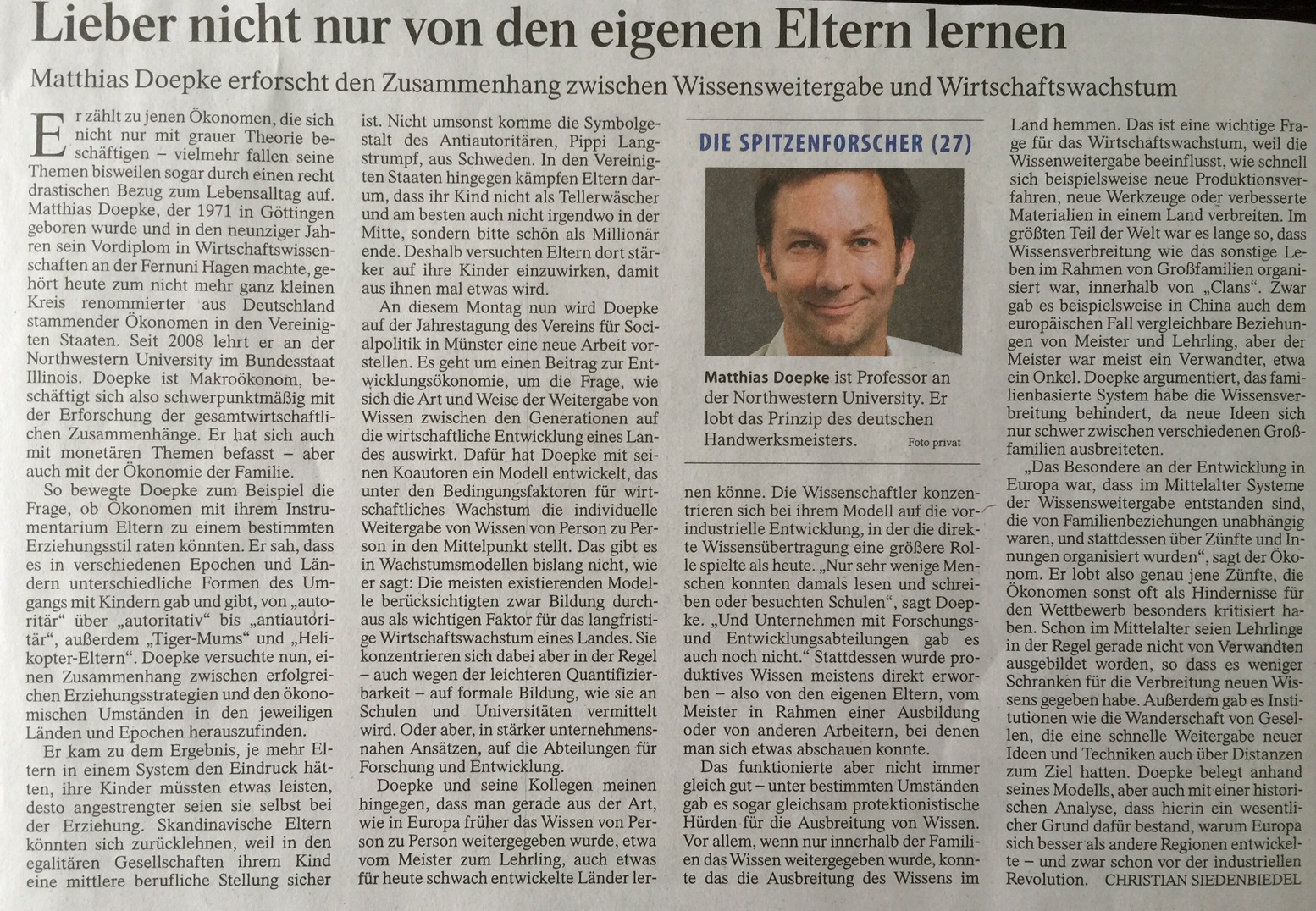
YouTube Video (in German) of interview discussion of this paper.
Money as a Unit of Account
With Martin Schneider
Econometrica, 85(5), 1537–1574, September 2017.
Abstract: We develop a theory that rationalizes the use of a dominant unit of account in an economy. Agents enter into non-contingent contracts with a variety of business partners. Trade unfolds sequentially in credit chains and is subject to random matching. By using a dominant unit of account, agents can lower their exposure to relative price risk, avoid costly default, and create more total surplus. We discuss conditions under which it is optimal to adopt circulating government paper as the dominant unit of account, and the optimal choice of "currency areas" when there is variation in the intensity of trade within and across regions.
Keywords: Unit of Account, Credit Chains, Balance Sheet Risk, Currency Areas
|
The article: [ PDF ] |
Working paper version (May 2017): [ PDF ] |
Online appendix:
[ PDF ]
Presentation slides:
[ PDF ]
Parenting with Style: Altruism and Paternalism in Intergenerational Preference Transmission
With Fabrizio Zilibotti
Econometrica, 85(5), 1331–1371, September 2017. Lead article.
Abstract: We develop a theory of parent-child relations that rationalizes the choice between alternative parenting styles (as set out in Baumrind 1967). Parents maximize an objective function that combines Beckerian altruism and paternalism towards children. They can affect their children's choices via two channels: either by influencing children's preferences or by imposing direct restrictions on their choice sets. Different parenting styles (authoritarian, authoritative, and permissive) emerge as equilibrium outcomes, and are affected both by parental preferences and by the socioeconomic environment. Parenting style, in turn, feeds back into the children's welfare and economic success. The theory is consistent with the decline of authoritarian parenting observed in industrialized countries, and with the greater prevalence of more permissive parenting in countries characterized by low inequality.
Keywords: Parenting Style, Intergenerational Preference Transmission, Paternalism, Occupational Choice.
|
The article: [ PDF ] |
Working paper version (May 2017): [ PDF ] |
Online appendix:
[ PDF ]
Presentation slides:
[ PDF ]
Codes and data:
[ zip file ]
A non-technical summary:
Tiger Moms and Helicopter Parents: The Economics of Parenting Style (Published in
Vox).
A discussion of the paper on nytimes.com by Anand Giridharadas: Unequal Societies Give an Incentive for Pushy Parenting.
An opinion piece by Pamela Druckerman on nytimes.com that cites the paper: A Cure for Hyper-Parenting.
A discussion in Chicago Magazine by Whet Moser: Why Are Helicopter Parents So Intense? Maybe They're Scared.
Interview with HCEO that includes a discussion of the paper: Matthias Doepke on Why He Studies Family Economics.
Fabrizio Zilibotti's honorary speech on 'Parenting with Style' at the XVI April International Academic Conference on Economic and Social Development in Moscow, April 15, 2015: Parenting Styles and Economics.
A podcast with Fabrizio Zilibotti discussing the paper: The Macro and Micro of Parenting.
A discussion in Les Echos by Jean-Marc Vittori: L'économie, les mamans tigres et les parents hélicoptères.
A discussion on Slate (French site) by Alphonse Corone: Plus vous vivez dans une société inégalitaire, moins vos parents vous laissent développer votre imagination, et inversement (sauf en France).
A discussion in La Repubblica by Rosaria Amato: Cosa rende i genitori severi o permissivi? La risposta degli economisti.
A discussion in Dagens Næringsliv by Eva Grinde: Like, rike og uoppdragne.
A podcast on Radio France by Charlie Dupiot: L'enfant optimiste.
Mentions and discussions of the paper at other places: Washington Post, NZZ am Sonntag, Frankfurter Allgemeine Sonntagszeitung, El Mundo, Aftenposten, Yale News, Calcalist, metafilter.com, Greg Mankiw's Blog, nuzzel.com, econoGIST, smartweek.it, The Telegraph, World Economic Forum, Quartz I, Quartz II, Nada es Gratis, Cafe, Iconomix, Observador, El Confidential, Hoje em Dia, Marginal Revolution.
YouTube Video of presentation of this paper at the Barcelona GSE Summer Forum.
Intrahousehold Decision Making and Fertility
With Fabian Kindermann
Published in Demographic Change and Long-Run Development, edited by Matteo Cervellati and Uwe Sunde, MIT Press, 2017.
Abstract: The economic theory of fertility choice builds predominantly on the unitary model of the household, in which there is a single household utility function and potential intra-household disagreement is abstracted from. Empirical evidence suggests, however, that many (potential) mothers and fathers disagree on whether to have children, on how many children to have, and on when to have them. In this paper, we review existing work that brings models of intrahousehold conflict and bargaining to bear on fertility choice, and we point out promising future directions for this line of research.
Keywords: Fertility, Bargaining, Child Care, Limited Commitment.
Working paper version (December 2014):
[ PDF ]
Families in Macroeconomics
With Michèle Tertilt
Handbook of Macroeconomics, Vol. 2, 1789-1891, December 2016.
Abstract: Much of macroeconomics is concerned with the allocation of physical capital, human capital, and labor over time and across people. The decisions on savings, education, and labor supply that generate these variables are made within families. Yet the family (and decision-making in families) is typically ignored in macroeconomic models. In this chapter, we argue that family economics should be an integral part of macroeconomics, and that accounting for the family leads to new answers to classic macro questions. Our discussion is organized around three themes. We start by focusing on short and medium run fluctuations, and argue that changes in family structure in recent decades have important repercussions for the determination of aggregate labor supply and savings. Next, we turn to economic growth, and describe how accounting for families is central for understanding differences between rich and poor countries and for the determinants of long-run development. We conclude with an analysis of the role of the family as a driver of political and institutional change.
Keywords: Macroeconomics, Families, Households, Bargaining, Fertility, Labor Supply.
|
The article: [ PDF ] |
Working paper version (March 2016): |
Codes and data:
[ zip file ]
Interview with HCEO that includes a discussion of the paper: Matthias Doepke on Why He Studies Family Economics.
The Baby Boom and World War II: A Macroeconomic Analysis
With Moshe Hazan and Yishay Maoz
Review of Economic Studies, 82(3), 1031-1073, July 2015.
Abstract: We argue that one major cause of the U.S. postwar baby boom was the rise in female labor supply during World War II. We develop a quantitative dynamic general equilibrium model with endogenous fertility and female labor-force participation decisions. We use the model to assess the impact of the war on female labor supply and fertility in the decades following the war. For the war generation of women, the high demand for female labor brought about by mobilization leads to an increase in labor supply that persists after the war. As a result, younger women who turn adult in the 1950s face increased labor-market competition, which impels them to exit the labor market and start having children earlier. The effect is amplified by the rise in taxes necessary to pay down wartime government debt. In our calibrated model, the war generates a substantial baby boom followed by a baby bust.
Keywords: Fertility, Female Labor-Market Participation, Baby Boom, World War II.
|
The article: [ PDF ] |
Working paper version (February 2015): [ PDF ] |
Online appendix (February 2015):
[ PDF ]
Presentation slides:
[ PDF ]
Codes and data:
[ zip file ]
A non-technical summary with a discussion of policy implications:
Europe's Fertility Crisis:
Lessons From the Post-War Baby Boom (published in
Vox).
Media coverage of this paper: The Economist.
A summary of the paper on the LSE USAPP blog:
How Rosie the Riveter led to the 1950s' Baby Boom.
Gary Becker on the Quantity and Quality of Children
Journal of Demographic Economics, 81(1), 59-66, March 2015.
Abstract: This paper reviews Gary Becker's contributions to the economic analysis of fertility, from his 1960 paper introducing the quantity-quality tradeoff to later work linking the economics of fertility to the theory of economic growth.
Keywords: Gary Becker, Fertility, Quantity-Quality Model, Demographic Transition.
|
The article: [ PDF ] |
Working paper version (November 2014): [ PDF ] |
Culture, Entrepreneurship, and Growth
With Fabrizio Zilibotti
Handbook of Economic Growth, Vol. 2, 1-48, December 2013.
Abstract: We discuss the two-way link between culture and economic growth. We present a model of endogenous technical change where growth is driven by the innovative activity of entrepreneurs. Entrepreneurship is risky and requires investments that affect the steepness of the lifetime consumption profile. As a consequence, the occupational choice of entrepreneurship hinges on risk tolerance and patience. Parents expecting their children to become entrepreneurs have an incentive to instill these two values in their children. Cultural transmission is Beckerian, i.e., parents are driven by the desire to maximize their children's happiness. We also consider, in an extension, a paternalistic motive for preference transmission. The growth rate of the economy depends on the fraction of the population choosing an entrepreneurial career. How many entrepreneurs there are in a society hinges, in turn, on parental investments in children's patience and risk tolerance. There can be multiple balanced-growth paths, where in faster-growing countries more people exhibit an ``entrepreneurial spirit." We discuss applications of models of endogenous preferences to the analysis of socio-economic transformations, such as the British Industrial Revolution. We also discuss empirical studies documenting the importance of culture and preference heterogeneity for economic growth.
Keywords: Culture, Entrepreneurship, Innovation, Economic Growth, Endogenous Preferences, Intergenerational Preference Transmission.
|
The article: [ PDF ] |
Working paper version (June 2013): [ PDF ] |
Exploitation, Altruism, and Social Welfare: An Economic Exploration
Politics, Philosophy & Economics, 12(4), 375-391, November 2013.
Abstract: Child labor is often condemned as a form of exploitation. I explore how the notion of exploitation, as used in everyday language, can be made precise in economic models of child labor. Exploitation is defined relative to a specific social welfare function. I first show that under the standard dynastic social welfare function, which is commonly applied to intergenerational models, child labor is never exploitative. In contrast, under an inclusive welfare function, which places additional weight on the welfare of children, child labor is always exploitative. Neither welfare function captures the more gradual distinctions that common usage of the term exploitation allows. I resolve this conflict by introducing a welfare function with minimum altruism, in which child labor in a given family is judged relative to a specific social standard. Under this criterion, child labor is exploitative only in families where the parent (or guardian) displays insufficient altruism towards the child. I argue that this welfare function best captures the conventional concept of exploitation and has useful properties for informing political choices regarding child labor.
Keywords: Child Labor, Exploitation, Social Welfare Function, Altruism.
|
The article: [ PDF ] |
Working paper version (June 2013): [ PDF ] |
The Economics and Politics of Women's Rights
With Michèle Tertilt and Alessandra Voena
Annual Review of Economics, 4, 339-372, July 2012.
Abstract: Women's rights and economic development are highly correlated. Today, the discrepancy between the legal rights of women and men is much larger in developing compared to developed countries. Historically, even in countries that are now rich women had few rights before economic development took off. Is development the cause of expanding women's rights, or conversely, do women's rights facilitate development? We argue that there is truth to both hypotheses. The literature on the economic consequences of women's rights documents that more rights for women lead to more spending on health and children, which should benefit development. The political-economy literature on the evolution of women's rights finds that technological change increased the costs of patriarchy for men, and thus contributed to expanding women's rights. Combining these perspectives, we discuss the theory of Doepke and Tertilt (2009), where an increase in the return to human capital induces men to vote for women's rights, which in turn promotes growth in human capital and income per capita.
Keywords: Women's Rights, Political Economy, Development.
|
The article: [ PDF | Link ] |
Working paper version (December 2011): [ PDF ] |
Small correction:
[ PDF ]
Data:
[ zip file ]
Discussion of this paper on the Economic Logic blog.
A piece in Diario Financiero by Rocío Vargas discussing the article: La influencia de los derechos de las mujeres sobra la economia y la politica.
A piece in Vox by Emily Stewart discussing the article: What voting has and hasn’t done for women.
Do International Labor Standards Contribute to the Persistence of the Child Labor Problem?
With Fabrizio Zilibotti
Journal of Economic Growth, 15(1), 1-31, March 2010. Lead article.
Abstract: In recent years, a number of governments and consumer groups in rich countries have tried to discourage the use of child labor in poor countries through measures such as product boycotts and the imposition of international labor standards. The purported objective of such measures is to reduce the incidence of child labor in developing countries and thereby improve children's welfare. In this paper, we examine the effects of such policies from a political-economy perspective. We show that these types of international action on child labor tend to lower domestic political support within developing countries for banning child labor. Hence, international labor standards and product boycotts may delay the ultimate eradication of child labor.
Keywords: Child Labor, Political Economy, International Labor Standards, Trade Sanctions.
|
The article: [ PDF ] |
Working paper version (November 2009): [ PDF ] |
Codes:
[ zip file ]
An opinion piece based on this research in
Room for Debate on nytimes.com:
Western Pressure Reduces Crucial Local Action to End Child Labor.
A non-technical summary with a discussion of policy implications:
Child Labor:
Is International Activism the Solution or the Problem? (Published in
Vox).
An editorial based on the paper (in German):
Warum
internationale Boykotte gegen Kinderarbeit die Lage eher verschlimmern als verbessern (Published in
GEO, July 2010).
Discussions of this paper on various blogs: Freakonomics, Economic Logic, Pixelökonom, EconoSpeak.
An article about this paper in Frankfurter Allgemeine Sonntagszeitung (in German): Kauft T-Shirts aus Kinderhand.
Women's Liberation: What's in It for Men?
With Michèle Tertilt
Quarterly Journal of Economics, 124(4), 1541-1591, November 2009.
Abstract: The nineteenth century witnessed dramatic improvements in the legal rights of married women. Given that they took place long before women gained the right to vote, these changes amounted to a voluntary renouncement of power by men. In this paper, we investigate men's incentives for sharing power with women. In our model, women's legal rights set the marital bargaining power of husbands and wives. We show that men face a tradeoff between the rights they want for their own wives (namely none) and the rights of other women in the economy. Men prefer other men's wives to have rights because men care about their own daughters and because an expansion of women's rights increases educational investments in children. We show that men may agree to relinquish some of their power once technological change increases the importance of human capital. We corroborate our argument with historical evidence on the expansion of women's rights in England and the United States.
Keywords: Women's Rights, Political Economy, Human Capital, Return to Education.
|
The article: [ PDF ] |
Working paper version with mathematical appendix (December 2008): [ PDF ] |
Presentation slides:
[ PDF ]
A non-technical summary:
Women's Rights: What's in It for Men? (published in
Vox).
Codes and data:
[ zip file ]
An interview discussing the paper:
The Emergence of Women's Rights and Gender Equality.
International Labor Standards and the Political Economy of Child Labor Regulation
With Fabrizio Zilibotti
Journal of the European Economic Association, 7(2-3), 508-518, April-May 2009.
Abstract: Child labor is a persistent phenomenon in many developing countries. In recent years, support has been growing among rich-country governments and consumer groups for the use of trade policies, such as product boycotts and the imposition of international labor standards, to reduce child labor in poor countries. In this paper, we discuss research on the long-run implications of such policies. In particular, we demonstrate that such measures may have the unintended side effect of lowering domestic support for banning child labor within developing countries, and thus may contribute to the persistence of the child-labor problem.
Keywords: Child Labor, Political Economy, International Labor Standards, Trade Sanctions.
|
The article: [ PDF ] |
Working paper version (September 2008): [ PDF ] |
Codes:
[ zip file ]
To Segregate or to Integrate:
Education Politics and Democracy
With David de la Croix
Review of Economic Studies, 76(2), 597-628, April 2009.
Abstract: How is the quality of public education affected by the presence of private schools for the rich? Theory and evidence suggest that the link depends crucially on the political system. We develop a theory that integrates private education and fertility decisions with voting on public schooling expenditures. We find that the presence of a large private education sector benefits public schools in a broad-based democracy where politicians are responsive to low-income families, but crowds out public-education spending in a society that is politically dominated by the rich. The main predictions of the theory are consistent with state-level and micro data from the United States as well as cross-country evidence from the PISA study.
Keywords: Public Education, Private Education, Probabilistic Voting, Democracy.
|
The article: [ PDF ] |
Working paper version (July 2008): [ PostScript | PDF ] |
Codes and data:
[ zip file ]
A non-technical summary: Politics and the Structure of Eduation Funding (published in Vox).
The same in French: Financement privé de l'éducation, inégalités et démocratie.
Occupational Choice and the Spirit of Capitalism
With Fabrizio Zilibotti
Quarterly Journal of Economics, 123(2), 747-793, May 2008.
Abstract: The British Industrial Revolution triggered a reversal in the social order whereby the landed elite was replaced by industrial capitalists rising from the middle classes as the economically dominant group. Many observers have linked this transformation to the contrast in values between a hard-working and thrifty middle class and an upper class imbued with disdain for work. We propose an economic theory of preference formation in which both the divergence of attitudes across social classes and the ensuing reversal of economic fortunes are equilibrium outcomes. In our theory, parents shape their children's preferences in response to economic incentives. If financial markets are imperfect, this results in the stratification of society along occupational lines. Middle-class families in occupations that require effort, skill, and experience develop patience and work ethic, whereas upper-class families relying on rental income cultivate a refined taste for leisure. These class-specific attitudes, which are rooted in the nature of pre-industrial professions, become key determinants of success once industrialization transforms the economic landscape.
Keywords: Endogenous Preferences, Social Classes, Stratification, Industrial Revolution.
|
The article: [ PDF ] |
Working paper version with mathematical appendix (September 2007): [ PostScript | PDF ] |
Presentation slides:
[ PDF ]
Codes:
[ zip file ]
Humankapital, politischer Wandel und langfristige Wirtschaftsentwickung
Plenary talk at the annual meeting of Verein für Socialpolitik 2007, published in Perspektiven der Wirtschaftspolitik, 9(3), 73-89, May 2008.
Abstract: Seit Mitte der achtziger Jahre hat die neue Wachstumstheorie verstärkt Aufmerksamkeit auf Humankapital als eine Quelle des Wirtschaftswachstums gelenkt. Neuere empirische Ergebnisse weisen allerdings darauf hin, dass Bildungsinvestitionen nur geringe soziale Externalitäten erzeugen und dass der direkte Beitrag des Humankapitals zum Wirtschaftswachstum relativ gering ist. In dieser Arbeit wird der Beitrag des Humankapitals zur Wirtschaftsentwicklung im Rahmen der langfristigen Wachstumstheorie dargestellt, deren Gegenstand ist, den Übergang von Ländern von vor-industrieller Stagnation zu stetigem Wirtschaftswachstum zu erklären. Hier erweist sich, dass Humankapital nicht nur direkte Produktivitätseffekte erzeugt, sondern auch als Auslöser verschiedener entwicklungsfördernder politischer Reformen dienen kann.
|
The article: [ PDF ] |
Working paper version (November 2007): [ PostScript | PDF ] |
Growth Takeoffs
Entry prepared for New Palgrave Dictionary of Economics, 2nd Edition.
Abstract: Following a phase of near-constant living standards lasting from Stone Age until the onset of the Industrial Revolution, a large number of countries have experienced growth takeoffs, in which stagnation gives way to sustained economic growth. What causes some countries to enter a growth takeoff, while others remain poor? We discuss three mechanisms that can trigger a growth takeoff in a country previously captured in a poverty trap: fertility decline, structural change, and accelerating technological progress.
Keywords: Industrial Revolution, Demographic Transition, Structural Change.
The paper (January 2006):
[ PostScript | PDF ]
Origins and Consequences of Child Labor Restrictions: A Macroeconomic Perspective
With Dirk Krueger
Published in Frontiers in Family Economics, edited by Peter Rupert, Emerald Press, 2008.
Abstract: In this paper we investigate the positive and normative consequences of child-labor restrictions for economic aggregates and welfare. We argue that even though the laissez-faire equilibrium may be inefficient, there are usually better policies to cure these inefficiencies than the imposition of a child-labor ban. Given this finding, we investigate the potential political-economic reasons behind the emergence and persistence of child-labor legislation. Our investigation is based on a structural dynamic general equilibrium model that provides a coherent and uniform framework for our analysis.
Keywords: Child Labor, Welfare, Efficiency, Political Economics.
Working paper version (October 2006):
[ PostScript | PDF ]
The Research Agenda: Matthias Doepke on the Transition from Stagnation to Growth
The EconomicDynamics Newsletter, 87(2), April 2007.
An overview of my research on economic growth.
Inflation and the Redistribution of Nominal Wealth
With Martin Schneider
Journal of Political Economy, 114(6), 1069-1097, December 2006.
Abstract: This study quantitatively assesses the effects of inflation through changes in the value of nominal assets. It documents nominal asset positions in the United States across sectors and groups of households and estimates the wealth redistribution caused by a moderate inflation episode. The main losers from inflation are rich, old households, the major bondholders in the economy. The main winners are young, middle-class households with fixed-rate mortgage debt. Besides transferring resources from the old to the young, inflation is a boon for the government and a tax on foreigners. Lately, the amount of U.S. nominal assets held by foreigners has grown dramatically, increasing the potential for a large inflation-induced wealth transfer from foreigners to domestic households.
Keywords: Inflation, Redistribution.
|
The article: [ PDF ] |
Working paper version (August 2006): [ PostScript | PDF ] |
|
Technical appendix: [ PostScript | PDF ] Codes and data: A discussion of the paper in Region Focus.
| |
Aggregate Implications of Wealth Redistribution:
The Case of Inflation
With Martin Schneider
Journal of the European Economic Association, 4(2-3), 493-502, April-May 2006.
Abstract: This paper shows that a zero-sum redistribution of wealth within a country can have persistent aggregate effects. Motivated by the case of an unanticipated inflation episode, we consider redistribution shocks that shift resources from old to young households. Aggregate effects arise because there are asymmetries in the reaction of winners and losers to changes in wealth. We focus on two sources of asymmetries: differences in the average age of winners and losers, and differences in their labor force status.
Keywords: Redistribution, Aggregate Effects.
|
The article: [ PDF ] |
Working paper version (October 2005): [ PostScript | PDF ] |
Dynamic Mechanism Design with Hidden Income and Hidden Actions
With Robert M. Townsend
Journal of Economic Theory 126(1), 235-285, January 2006.
Abstract: We develop general recursive methods to solve for optimal contracts in dynamic principal-agent environments with hidden states and hidden actions. In our baseline model, the principal observes nothing other than transfers. Nevertheless, optimal incentive-constrained insurance can be attained. Starting from a general mechanism with arbitrary communication, randomization, full history dependence, and without restrictions on preferences or technology, we show how the optimal contract can be efficiently implemented as a recursive direct mechanism. Our methods generalize to environments with multiple actions and additional states, some of which may be observable. The key to implementing these extensions is to introduce multiple layers of off-path utility bounds.
Keywords: Mechanism Design, Partial Insurance, Dynamic Contracts.
|
The article: [ PDF ] |
Working paper version (August 2004): [ PostScript | PDF ] |
Earlier versions with additional proofs and
numerical results:
| April 2003: | [ PostScript | PDF, Appendix: PostScript | PDF ] |
| April 2002: | [ PostScript | PDF ] |
| August 2001: | [ PostScript | PDF ] |
Codes:
[ zip file ]
The Macroeconomics of Child Labor Regulation
With Fabrizio Zilibotti
American Economic Review 95(5), 1492-1524, December 2005.
Abstract: We develop a positive theory of the adoption of child labor laws. Workers who compete with children in the labor market support the introduction of a child labor ban, unless their own working children provide a large fraction of family income. Fertility decisions lock agents into specific political preferences, and multiple steady states can arise. The introduction of child labor laws can be triggered by skill-biased technological change that induces parents to choose smaller families. The theory can account for the observation that in Britain regulations were first introduced after a period of rising wage inequality, and coincided with rapid fertility decline.
Keywords: Child Labor, Voting, Fertility, Inequality.
An earlier version of this paper circulated under the title: "Voting with your Children: A Positive Analysis of Child-Labor Laws."
|
The article: [ PDF ] |
Working paper version (May 2005): [ PostScript | PDF ] |
Presentation slides:
[ PDF ]
Codes and data:
[ zip file ]
Read an article in The Region about this paper: Why Johnny Can't Work
A static version of the model that illustrates the main ideas in a simplified framework (useful for teaching purposes).
Child Mortality and Fertility Decline: Does the Barro-Becker Model Fit the Facts?
Journal of Population Economics 18(2), 337-366, June 2005.
Abstract: I compare the predictions of three variants of the altruistic parent model of Barro and Becker for the relationship between child mortality and fertility. In the baseline model fertility choice is continuous, and there is no uncertainty over the number of surviving children. The baseline model is contrasted to an extension with discrete fertility choice and stochastic mortality and a setup with sequential fertility choice. The quantitative predictions of the models are remarkably similar. While in each model the total fertility rate falls as child mortality declines, the number of surviving children increases. The results suggest that factors other than declining infant and child mortality are responsible for the large decline in net reproduction rates observed in industrialized countries over the last century.
Keywords: Fertility, Infant Mortality, Child Mortality, Demographic Transition.
|
The article: [ PDF ] |
Working paper version (April 2004): [ PostScript | PDF ] |
Codes:
[ zip file ]
Social Class and the Spirit of Capitalism
With Fabrizio Zilibotti
Journal of the European Economic Association 3(2-3), 516-524, April-May 2005.
Abstract: The British Industrial Revolution was a time of major socio-economic transformations. We review a number of recent economic theories which analyze the transition from a preindustrial world characterized by high fertility, stationary standards of living, and rigid social hierarchies to modern capitalism. One of the key social transformations that accompanied the Industrial Revolution was the economic decline of the aristocracy. Standard theories of wealth inequality cannot explain why the aristocrats, in spite of their superior wealth and education, failed to be the main protagonists and beneficiaries of industrialization. We discuss recent research based on a model of endogenous preferences that is consistent with the demise of aristocracy.
Keywords: Endogenous Preferences, Industrial Revolution, Social Class.
|
The article: [ PDF ] |
Working paper version (September 2004): [ PostScript | PDF ] |
Show Me the Money: Retained Earnings and the Real Effects of Monetary Shocks
Recherches Economiques de Louvain, 71(1), 5-34, 2005.
Abstract: The empirical literature on monetary policy shocks documents that contractionary shocks are followed by a persistent rise in interest rates and a persistent fall in output. Standard monetary business cycle models can account for the initial effects of monetary shocks, but have difficulty generating persistence. In this paper, I examine whether frictions that affect the asset allocation decisions of households can lead to persistent effects. In the model economy, households hold two assets, one used for transactions (the checking account) and one used for investment (the savings account). There is a small transaction cost for moving funds between the accounts. Another key feature of the economy is that the business sector accumulates retained earnings and credits profits to the consumers only with a delay. I show that in this environment monetary shocks have persistent effects even when the adjustment cost is very small.
Keywords: Monetary Shocks, Retained Earnings, Persistence, Business Cycles, Flow of Funds.
|
The article: [ PDF ] |
Working paper version (November 2003): [ PostScript | PDF ] |
Codes:
[ zip file ]
Accounting for Fertility Decline During
the Transition to Growth
Journal of Economic Growth 9(3), 347-383, September 2004.
Abstract: In every developed country, the economic transition from pre-industrial stagnation to modern growth was accompanied by a demographic transition from high to low fertility. Even though the overall pattern is repeated, there are large cross-country variations in the timing and speed of the demographic transition. What accounts for falling fertility during the transition to growth? To answer this question, this paper develops a unified growth model which delivers a transition from stagnation to growth, accompanied by declining fertility. The model is used to determine whether government policies that affect the opportunity cost of education can account for cross-country variations in fertility decline. Among the policies considered, education subsidies have only minor effects, while accounting for child-labor regulations is crucial. Apart from influencing fertility, the policies also have large effects on the evolution of the income distribution in the course of development.
Keywords: Growth, Fertility, Demographic Transition, Education, Child Labor, Income Distribution.
|
The article: [ PDF ] |
Working paper version (May 2004): [ PostScript | PDF ] |
An earlier, more detailed version under the title "Growth and Fertility in the Long Run"
is also available (May 2000):
[ PostScript | PDF ]
Codes and data:
[ zip file ]
Public versus Private Education when Differential Fertility Matters
With David de la Croix
Journal of Development Economics 73(2), 607-629, April 2004.
Abstract: We assess the merits of different education systems in a framework that accounts for the joint decision problem of parents regarding fertility and education. Specifically, we compare the implications of a public and a private schooling regime for economic growth and inequality. We find that private schooling leads to higher growth when there is little inequality in human capital endowments across families. In contrast, when inequality is high, public education yields higher growth by reducing fertility differentials. In addition, public schooling leads to income convergence, while private schooling can result in ever increasing inequality. Our analysis highlights the importance of accounting for endogenous fertility differentials when analyzing educational policies.
Keywords: Growth, Inequality, Fertility, Public Education, Private Education.
|
The article: [ PDF ] |
Working paper version (April 2003): [ PostScript | PDF ] |
Codes:
[ zip file ]
Inequality and Growth: Why Differential Fertility Matters
With David de la Croix
American Economic Review 93(4), 1091-1113, September 2003.
Abstract: We develop a new theoretical link between inequality and growth. In our model, fertility and education decisions are interdependent. Poor parents decide to have many children and invest little in education. A mean-preserving spread in the income distribution increases the fertility differential between the rich and the poor, which implies that more weight gets placed on families who provide little education. Consequently, an increase in inequality lowers average education and, therefore, growth. We find that this fertility-differential effect accounts for most of the empirical relationship between inequality and growth.
Keywords: Growth, Inequality, Differential Fertility, Human Capital, Education.
|
The article: [ PDF ] |
Working paper version (September 2002): [ PostScript | PDF ] |
Codes and data:
[ zip file ]
Research papers presented on this page are based upon work supported by the National Science Foundation under grants No. SES-0217051, SES-0519265, SES-0820409, and SES-1260961.